Wednesday, June 27, 2007

The Making of an American Soldier: Why Young People Join the Military

By Jorge Mariscal, Sojourners. AlterNet.com

Posted June 26, 2007.

George Bush likes to say it's because they're patriots, but the truth may have more to do with financial need and recruiters targeting those with limited economic options.
062607story

In today's political climate, with two wars being fought with no end in sight, it can be difficult for some people to understand why young folks enlist in our military.

The conservative claim that most youth enlist due to patriotism and the desire to "serve one's country" is misleading. The Pentagon's own surveys show that something vague and abstract called "duty to country" motivates only a portion of enlistees.

The vast majority of young people wind up in the military for different reasons, ranging from economic pressure to the desire to escape a dead-end situation at home to the promise of citizenship.

Over all, disenfranchisement may be one of the most accurate words for why some youth enlist.

Read more

Friday, June 22, 2007

Documentary: Law gives military access to student data

WASHINGTON — It began as a class assignment for Alexia Welch and Sarah Ybarra: Make a five-minute video news story about advertising in public schools.

But the Lawrence, Kan., teenagers' project snowballed into a 25-minute documentary on how the federal No Child Left Behind law to improve education promotes military recruitment, infringes on students' privacy and encourages school officials to look the other way.

The movie's fans include a Democratic California congressman who's been trying to change the law for two years and award-winning liberal filmmaker Robert Greenwald, who viewed some early rushes and offered the pair his lawyer's services, just in case.

Their film, "No Child Left Unrecruited," premiered in April at an arts center in Lawrence, the home of the University of Kansas. A short trailer on YouTube has gotten 630 hits in the past month, and the film made its Washington debut Tuesday.

"We found out this wasn't a school assignment anymore," said 17-year-old Ybarra, who'll be a senior next fall at Lawrence High School. "This was going to go beyond the walls of the district."

Read more

Thursday, June 21, 2007

Seattle Students Shut Down School Board Demanding Military Recruiters Out of Schools

By Philip Locker, Dylan Simpson, and Marianne Mork
June 21, 2007

“What do we want? Recruiters out! When do we want it? Now!” chanted over 70 antiwar protestors as we marched into to the Seattle School Board meeting Wednesday night. The spirited protest, called by Youth Against War and Racism (YAWR), demanded the school board finally take real action against military recruitment in our schools. As the local TV news King 5 said, it was “intended to be political high theatre, and it certainly was effective.” Another reporter commented: “it was the most dramatic anti-military recruitment rally to date.”

YAWR is calling for military recruiters to be banned from Seattle public schools. But to stay within the legal paramaters of the “No Child Left Behind” law, we are demanding that all recruiting be done at a district-wide recruitment fair once a semester. This would create equity between the access to students that the military, college, and job recruiters have. Currently, military recruiters have a massive budget and a huge advantage over college and job recruiters. A district-wide recruitment fair would also stop military recruiters from carrying out their predatory tactics within our schools and disproportionate targeting of schools that are predominantly made up of poor and minority students.

Read more

Links to Mainstream Media Coverage
KOMO 4 Video coverage: http://www.komotv.com/news/8105247.html (click WATCH THE STORY below the picture)

King 5 Video coverage: http://www.king5.com/video/featured-index.html?nvid=153224

Seattle Times: http://seattletimes.nwsource.com/html/localnews/2003756523_assignment21m.html

Wednesday, June 13, 2007

NCLB and the Military: A California teacher union passes antirecruitment resolution

ZNet, by Gregory Sotir of Rethinking Schools June 3, 2007
The British navy used to use trapdoors in barrooms to capture recruits to maintain its colonial empire. The U.S. military doesn't need these tricks. It has No Child Left Behind.

Section 9528, the 300 or so words buried within the act's 670 pages, cement militarism in public schools. This section's provisions funnel private student data such as telephone numbers and home addresses into the Pentagon for military recruitment purposes and also mandate access for military recruiters to students in public secondary schools.

As the wars in Iraq and Afghanistan have dragged on, recruiters have become increasingly aggressive on campus. Data from student information provided via Section 9528 are used for recruiter home visits and repetitive phone calls to students. Military recruiters also use high-pressure sales techniques, flashy videos, and eye-candy trinkets, and bring he-man danger mobiles such as Hummers and helicopters onto school grounds to attract students, especially young males. At the beginning of this school year, the Los Angeles-based Coalition Against Militarism In Our Schools (CAMS), a group that I work with, decided to get the word out about Section 9528.
Read article

Saturday, June 2, 2007

Fewer high-quality Army recruits

As war needs rise, exam scores drop

WASHINGTON -- The percentage of high-quality recruits entering the Army is the lowest in 10 years, an indication that the force is struggling to attract top-grade enlistees -- and a troubling sign for the Pentagon, which is waging wars in Iraq and Afghanistan and plans to add 90,000 ground troops to its ranks within the next five years.

Over the past decade, the percentage of top-level recruits who enlisted in the Army was mostly consistent, dipping slightly at the end of the 1990s before spiking in the wake of the Sept. 11, 2001, terrorist attacks. But since 2003 -- the same year the US invaded Iraq -- the Army has steadily taken in more recruits that the force itself considers "non-high quality."

Last year, nearly 40 percent of those who joined the Army had below-average verbal and math scores on the Armed Forces Qualification Test, a mandatory exam that helps the military determine a recruit's aptitude and mental proficiency. In 2003, the Army accepted only 28.9 percent of the low-scoring recruits, but that percentage gradually began to rise in subsequent years, according to Army statistics.

Read article

Thursday, May 17, 2007

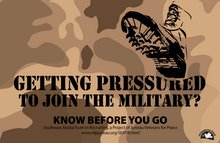
“Know All You Can Know” Before You Enlist!

What are we telling young people? You wouldn’t buy a car without taking a look at its record for reliability and safety. If you are considering military service, it is important to understand what you are signing up for. The military is a job you cannot quit. Joining the military is a serious decision, and we urge people making choices about the next stage of their lives to be informed and careful.

Who are we to criticize the military? We believe that if the military is a volunteer force, everyone who joins should be a true volunteer. No one should join the military without deciding that he or she is willing to kill and die in a war. SEATIR encourages people thinking about joining the military to research, ask questions, take time and know all they can know before making a decision to enlist.

Where do we get our information? Our sources include, among others, the U.S. Departments of Defense and Veterans Affairs and newspapers such as the Army Times, as well as academic studies. The information is gathered by organizations including the American Friends Service Committee (AFSC), Veterans for Peace, the War Resisters League and the Central Committee for Conscientious Objectors (CCCO). This year, the CCCO estimates it has received about 10,000 calls from personnel who want to get out of the military.

Sunday, March 18, 2007

The Women’s War

From The New York Times

Katy Grannan for The New York Times;

Suzanne Swift Just before she was to leave for her second tour in Iraq, she told her mother: "I can't do this. I can't go back there."

Published: March 18, 2007

Editors' Note Appended

On the morning of Monday, Jan. 9, 2006, a 21-year-old Army specialist named Suzanne Swift went AWOL. Her unit, the 54th Military Police Company, out of Fort Lewis, Wash., was two days away from leaving for Iraq. Swift and her platoon had been home less than a year, having completed one 12-month tour of duty in February 2005, and now the rumor was that they were headed to Baghdad to run a detention center. The footlockers were packed. The company's 130 soldiers had been granted a weekend leave in order to go where they needed to go, to say whatever goodbyes needed saying. When they reassembled at 7 a.m. that Monday, uniformed and standing in immaculate rows, Specialist Swift, who during the first deployment drove a Humvee on combat patrols near Karbala, was not among them.

Swift would later say that she had every intention of going back to Iraq. But in the weeks leading up to the departure date, she started to feel increasingly anxious. She was irritable, had trouble sleeping at night, picked fights with friends, drank heavily. ''I was having a lot of little freakouts,'' she told me when I went to visit her in Washington State last summer. ''But I was also ready to go. I was like, 'O.K., I can do this.''' Read article

Wednesday, March 7, 2007

The private war of women soldiers

Many female soldiers say they are sexually assaulted by their male comrades and can't trust the military to protect them. "The knife wasn't for the Iraqis," says one woman. "It was for the guys on my own side."

Editor's note: This story has been corrected since it was originally published.

By Helen Benedict

story image

March 7, 2007 | As thousands of burned-out soldiers prepare to return to Iraq to fill President Bush's unwelcome call for at least 20,000 more troops, I can't help wondering what the women among those troops will have to face. And I don't mean only the hardships of war, the killing of civilians, the bombs and mortars, the heat and sleeplessness and fear.

I mean from their own comrades -- the men.

I have talked to more than 20 female veterans of the Iraq war in the past few months, interviewing them for up to 10 hours each for a book I am writing on the topic, and every one of them said the danger of rape by other soldiers is so widely recognized in Iraq that their officers routinely told them not to go to the latrines or showers without another woman for protection.

The female soldiers who were at Camp Arifjan in Kuwait, for example, where U.S. troops go to demobilize, told me they were warned not to go out at night alone. Read article