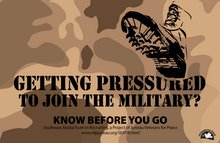
Showing posts with label women in the military. Show all posts

Friday, April 15, 2011

There's No Quick Fix for Veterans

MAGGIE MARTIN

Huffington Post Posted: 04/13/11 08:25 PM ET

It has been nearly five years since I left the Army and still my time in the service is fresh in my mind. I think about my deployments every single day without fail. I have friends and family, responsibilities and passions that keep me moving, but the time I spent in the Army and in Iraq are what continue to define me.
Many current and former service members feel the same way. The act of participating in war casts a shadow over everything else in life. Facing high stress and danger for so long makes it tremendously difficult to leave the military and rejoin civilian society. Day-to-day concerns seem trivial compared to the life or death urgency of military situations. When I first came home, I would become furious at how easily everyone in this country can carry on virtually ignoring the fact that we are at war.
I worked as a server as I used my GI Bill benefits to earn a bachelor's degree in English Communication, but after graduating with honors, I could not find a job in my field. After a year of looking for meaningful employment, I enrolled in graduate school largely out of fear that my degree would become obsolete before I could even get a shot at any real work experience. The fact that women veterans are among the highest unemployed populations leaves me with questions about whether my service is continuing to hurt me in ways I cannot even see.  Read more


Maggie Martin served as a Sergeant in the US Army Signal Corps, and she served two tours in Iraq.  She is an organizer with Iraq Veterans Against the War's Operation Recovery Campaign and the Warrior Writers project.  Maggie is presently a graduate student at Marygrove College in Detroit, Michigan, and her poetry has been published in Fellowship Magazine.

Thursday, August 7, 2008

Pushing Back at Pushy Recruiters

jay street
Pictured here are three of the artists working on a mural in Sunset Park. (Photos: David Gonzalez/The New York Times)

A mural that is slowly going up on the industrial edge of Sunset Park is shaping up to be one huge Do Not Disturb sign directed at military recruiters. Its creators? A group of young women — barely out of high school — who are still smarting from what they saw as repeated and unwanted come-ons from recruiters who would stop them on the street, in school or call them at home.

“If you go to some Manhattan schools or places where the families have a higher income, you don’t see the recruiters there,” said Ebony Thurman, 18, who was once approached by recruiters at the Atlantic Avenue subway station. “But if you’re in Brooklyn or in lower income neighborhoods, that’s where you really find them trying to recruit people. They tell you that you’ll get job skills or college money. And if you’re a girl they’ll flirt with you and say there a lot of cute guys you could meet if you enlist.” Read more

Sunday, July 13, 2008

Home from the Military

COLORLINES The National newsmagazine on race and politics
July/August 2008
By Michelle Chen
WHEN KRISTINA MCCAULEY LOOKS BACK on her time in boot camp, one scene sticks out: she’s standing in the sun as blood flows down her wrist, hoping no one will notice her among the rows of trainees chanting and brandishing bayonets. Thinking back, she’s not sure why she grabbed her weapon the wrong way during that drill. But when she saw that the bayonet on her rifle had sliced cleanly across her hand, she knew calling for help would only invite her drill sergeants to make her life more miserable. “I was just standing out there in the heat of the day and bleeding and trying to be quiet about it,” she recalled later in an interview. Soon, a female drill sergeant came over to berate her for her stupidity—as a lesson to the other trainees—and tossed a few bandages at her. Read entire article

Sunday, December 9, 2007

Female GIs complain of unequal treatment

By MATHEW D. LAPLANTE

Salt Lake Tribune
Friday, November 09, 2007

The soldiers outside her room were drunken and indignant.

"Why won't you date any of us, bitch?" Amanda Blume recalled one of the men demanded before he helped kick in her barracks door.

Inside, Blume remembered, she was surrounded, called names and pushed into a corner. Fearing for her safety, she said, she fought her way free, striking one of the men in the face on the way out.

The next week, Blume's Army commanders in Fort Sill, Okla., charged her with assault.

The exact details of what happened in the barracks on that night last March are known only to Blume and the men she has accused of attacking her. But in punishing the female soldier, Blume's male commanders followed a pattern that advocates of female service members call "epidemic" -- a pattern that nearly repeated itself again to Blume just a few months later.

Honorably discharged in early July, Blume remains proud of her military service, which began the month after she graduated from high school in 2004. As a whole, she said, the experience was positive. But it also was punctuated by moments that were alternately frightening, demeaning and unjust.

The day after Blume was attacked in her room, she was called in to see her commanding officer. "I thought he would help me, but that's not what happened," she said.

The man she'd struck had already been in to file a complaint. Read article


Sunday, November 4, 2007

Life as an American Female Soldier


Marie Claire

Hair falling out, periods on hold, and peeing in a cup: for female soldiers, life on the front lines involves stuff men never have to think about.

By Tara McKelvey

I signed up for the army in June 2001, when I was 17. They were offering to pay for some of my college education. I wasn't concerned about the possibility of going to war; I just kept thinking, This is going to be cool.

Two years later, I was a sophomore at the University of Illinois in Urbana, and I got a phone call from my platoon sergeant, who said, "Your unit has been put on alert." That evening, I went to see The Vagina Monologues at a local theater with friends from my dorm. I didn't say anything about the phone call. On November 11, Veterans Day, I was told I was being deployed. I quit my part-time job at David's Bridal shop and boxed up the clothes in my dorm.

In February, I went to a base in Kuwait, where you had to wait in long lines no matter where you were: in the mess hall, bathroom, shower. You were never alone. At night, I put on headphones and played Norah Jones to block it all out. Read more

Sunday, October 28, 2007

Letter to the Editor: Women face risks if they join military

Web posted October 28, 2007

Whether the National Guard recruiters like it or not, young women and their parents should know that thousands of American women in uniform are being raped by their fellow soldiers. In 2005, the Veterans Administration released a 2001 study on the National Guard and Reserves. It found that 60 percent of women Reservists and National Guard had experienced some kind of sexual trauma (Washington Post on Sept. 30, 2005).

Sexual assault is so pervasive that the VA has a name for it - Military Sexual Trauma. Female soldiers suffering from post-traumatic stress disorder as a result of military sexual trauma were on the "NOW with David Brancaccio" program on Sept. 7 (pbs.org). Women are dying, losing legs and arms, and suffering brain injuries in Iraq. It's a terrible injustice that they have to watch their backs with their own countrymen.

Personal stories of military women in Iraq are in "The private war of female soldiers" by Helen Benedict (Salon.com, on March 7). One story tells of three female soldiers who died of dehydration because they refused to drink liquids late in the day. They were afraid of being raped by male soldiers if they walked to the latrines after dark. That story is in the brochure distributed at the high school.

Women report that if the commanding officer has a zero-tolerance for sexual abuse, it doesn't happen. Unlike civilians, soldiers can't choose where they work and they can't quit.

Speaking the truth isn't being against the troops. The troops include women. Juneau School Board member Margo Waring was doing her job. (Waring said in a recent meeting that military recruitment is limited to three days at Juneau-Douglas High School because it does not serve the Juneau School District's education mission. She also said the war is seen as controversial.)

Young women need this information to make an informed decision. They must weigh the benefits against the risks.

Barbara Belknap

Juneau

Sunday, March 18, 2007

The Women’s War

From The New York Times

Katy Grannan for The New York Times;

Suzanne Swift Just before she was to leave for her second tour in Iraq, she told her mother: "I can't do this. I can't go back there."

Published: March 18, 2007

Editors' Note Appended

On the morning of Monday, Jan. 9, 2006, a 21-year-old Army specialist named Suzanne Swift went AWOL. Her unit, the 54th Military Police Company, out of Fort Lewis, Wash., was two days away from leaving for Iraq. Swift and her platoon had been home less than a year, having completed one 12-month tour of duty in February 2005, and now the rumor was that they were headed to Baghdad to run a detention center. The footlockers were packed. The company's 130 soldiers had been granted a weekend leave in order to go where they needed to go, to say whatever goodbyes needed saying. When they reassembled at 7 a.m. that Monday, uniformed and standing in immaculate rows, Specialist Swift, who during the first deployment drove a Humvee on combat patrols near Karbala, was not among them.

Swift would later say that she had every intention of going back to Iraq. But in the weeks leading up to the departure date, she started to feel increasingly anxious. She was irritable, had trouble sleeping at night, picked fights with friends, drank heavily. ''I was having a lot of little freakouts,'' she told me when I went to visit her in Washington State last summer. ''But I was also ready to go. I was like, 'O.K., I can do this.''' Read article

Wednesday, March 7, 2007

The private war of women soldiers

Many female soldiers say they are sexually assaulted by their male comrades and can't trust the military to protect them. "The knife wasn't for the Iraqis," says one woman. "It was for the guys on my own side."

Editor's note: This story has been corrected since it was originally published.

By Helen Benedict

story image

March 7, 2007 | As thousands of burned-out soldiers prepare to return to Iraq to fill President Bush's unwelcome call for at least 20,000 more troops, I can't help wondering what the women among those troops will have to face. And I don't mean only the hardships of war, the killing of civilians, the bombs and mortars, the heat and sleeplessness and fear.

I mean from their own comrades -- the men.

I have talked to more than 20 female veterans of the Iraq war in the past few months, interviewing them for up to 10 hours each for a book I am writing on the topic, and every one of them said the danger of rape by other soldiers is so widely recognized in Iraq that their officers routinely told them not to go to the latrines or showers without another woman for protection.

The female soldiers who were at Camp Arifjan in Kuwait, for example, where U.S. troops go to demobilize, told me they were warned not to go out at night alone. Read article